
Modafinil vs Armodafinil vs Adderall vs Ritalin: What’s the Difference?
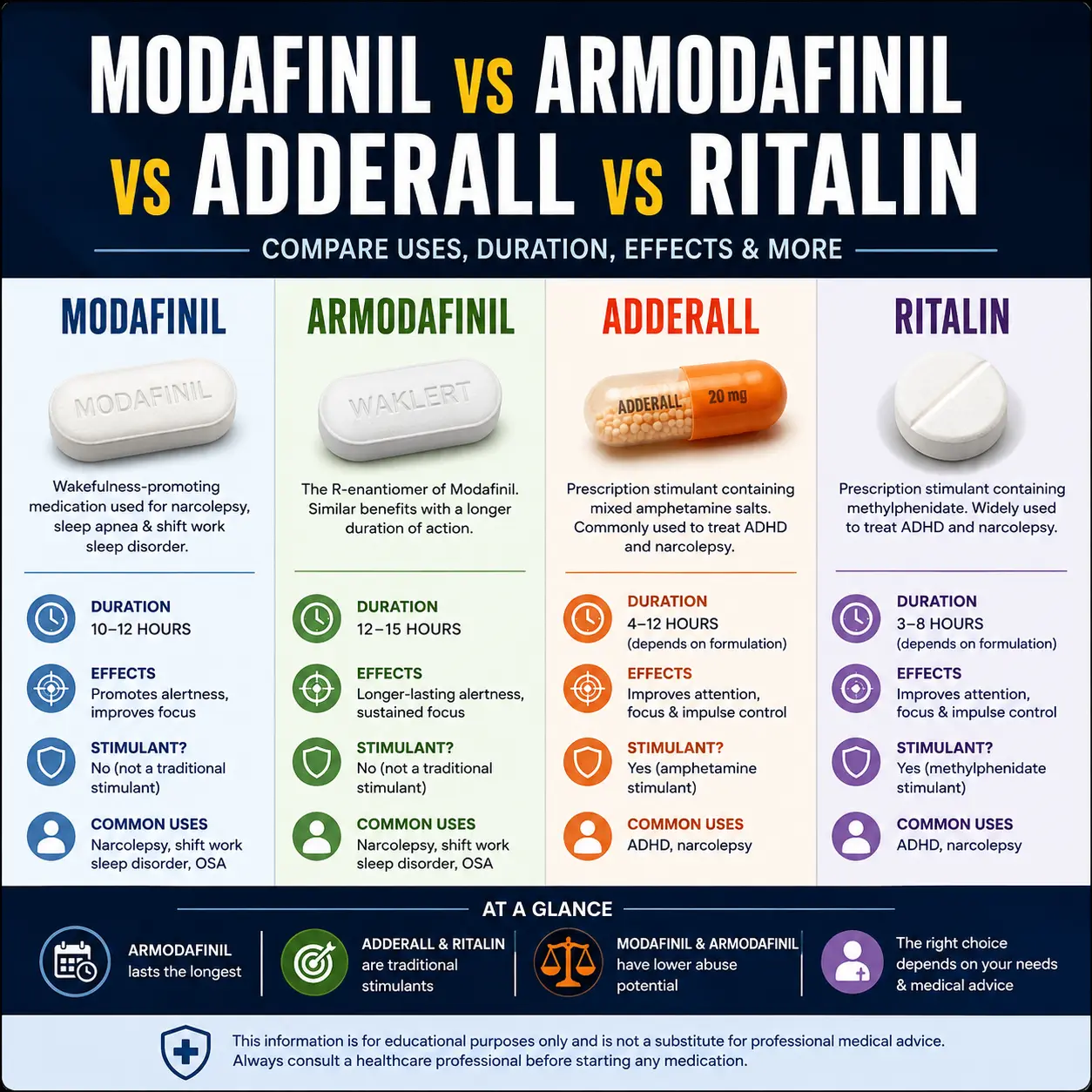
If you’ve been researching medications to improve focus, alertness, or productivity, you’ve probably come across four names repeatedly: Modafinil, Armodafinil, Adderall, and Ritalin.
Although they’re often grouped together, they work quite differently and are prescribed for different reasons. Understanding these differences can help you have a more informed discussion with your healthcare provider.
Quick Comparison
| Medication | Generic Name | Primary Use | Typical Duration | Stimulant? |
|---|---|---|---|---|
| Modafinil | Modafinil | Wakefulness, narcolepsy, shift work sleep disorder | 10–12 hours | No (wakefulness-promoting agent) |
| Armodafinil | Armodafinil | Same as Modafinil | 12–15 hours | No (wakefulness-promoting agent) |
| Adderall | Mixed amphetamine salts | ADHD, narcolepsy | 4–12 hours (depending on formulation) | Yes |
| Ritalin | Methylphenidate | ADHD, narcolepsy | 3–8 hours (depending on formulation) | Yes |
Modafinil
Modafinil is a prescription medication primarily approved for excessive daytime sleepiness associated with conditions such as narcolepsy, obstructive sleep apnea, and shift work sleep disorder.
Many patients appreciate that it promotes wakefulness throughout the day while often producing less jitteriness than traditional stimulant medications.
Common characteristics
- Promotes wakefulness
- May support sustained attention in some individuals
- Lower abuse potential than amphetamine-based stimulants
- Usually taken once daily
- Often preferred for long workdays
Popular brands include Modalert®, Modvigil®, and Modawake®.
Armodafinil
Armodafinil is closely related to Modafinil but contains only the active R-enantiomer, which generally remains in the body longer.
Many people report that Armodafinil has a smoother effect later in the day and may maintain alertness for longer, although individual responses vary.
Common characteristics
- Longer-lasting than Modafinil
- Usually taken once daily
- May provide sustained wakefulness into the afternoon or evening
- Similar approved medical uses
Popular brands include Waklert® and Nuvigil®.
Adderall
Adderall is a central nervous system stimulant containing mixed amphetamine salts. It is commonly prescribed for ADHD and narcolepsy.
Because it directly increases dopamine and norepinephrine activity, many patients experience significant improvements in attention and concentration when appropriately prescribed.
Common characteristics
- Prescription stimulant
- Often produces noticeable increases in focus
- Available in immediate-release and extended-release formulations
- Higher abuse and dependence potential than Modafinil or Armodafinil
Ritalin
Ritalin contains methylphenidate, another prescription stimulant widely used for ADHD.
Although it shares similarities with Adderall, its pharmacology differs, and some individuals respond better to one medication than the other.
Common characteristics
- Prescription stimulant
- Usually shorter acting than many extended-release amphetamine products
- Available in several formulations
- Commonly prescribed for children and adults with ADHD
Which One Lasts the Longest?
Approximate duration:
- Armodafinil: 12–15 hours
- Modafinil: 10–12 hours
- Adderall XR: up to 12 hours
- Adderall IR: 4–6 hours
- Ritalin IR: 3–4 hours
Actual duration varies depending on the individual, dose, metabolism, and formulation.
Which Is Better for Focus?
There isn’t a universally “best” medication.
Generally speaking:
- Modafinil is commonly prescribed to promote wakefulness and may help some people maintain alertness.
- Armodafinil offers similar effects but often lasts longer.
- Adderall is a first-line treatment for many people with ADHD.
- Ritalin is another established ADHD treatment and may be preferred depending on the individual’s response.
The right medication depends on your diagnosis, medical history, other medications, and advice from a qualified healthcare professional.
Side Effects
All prescription medications can cause side effects.
Modafinil / Armodafinil
Possible side effects include:
- Headache
- Nausea
- Dry mouth
- Reduced appetite
- Difficulty sleeping if taken late in the day
Rare but serious allergic skin reactions have been reported. Seek medical attention immediately if you develop a rash or other signs of a severe reaction.
Adderall / Ritalin
Possible side effects include:
- Increased heart rate
- Elevated blood pressure
- Appetite suppression
- Insomnia
- Anxiety or nervousness
Because they are stimulant medications, they also carry risks of misuse, dependence, and withdrawal.
At a Glance
Choose Modafinil if:
- Wakefulness is the primary goal
- You need all-day alertness
- You’re looking for a non-amphetamine wakefulness-promoting medication
Choose Armodafinil if:
- You prefer longer-lasting effects
- You often need alertness into the evening
- You responded well to Modafinil but want longer coverage
Choose Adderall if:
- You have ADHD and your healthcare provider recommends an amphetamine-based treatment
Choose Ritalin if:
- You have ADHD and methylphenidate is considered the more appropriate option by your healthcare provider
Final Thoughts
Although these four medications are often discussed together, they serve different clinical purposes.
Modafinil and Armodafinil are wakefulness-promoting medications primarily used for disorders involving excessive daytime sleepiness, while Adderall and Ritalin are stimulant medications most commonly prescribed for ADHD.
The most suitable option depends on your medical needs, health history, and professional medical advice. Never start, stop, or change prescription medication without consulting your healthcare provider.
Frequently Asked Questions
Is Armodafinil stronger than Modafinil?
Not necessarily. Many users find that Armodafinil lasts longer rather than feeling dramatically stronger.
Is Modafinil an amphetamine?
No. Modafinil is not an amphetamine and is classified as a wakefulness-promoting agent.
Which medication lasts the longest?
Armodafinil generally has the longest duration among the four medications discussed.
Can you switch between these medications?
Any changes between prescription medications should only be made under the supervision of a qualified healthcare professional.
Disclaimer: This article is intended for educational purposes only and should not be considered medical advice. Always consult a qualified healthcare professional regarding diagnosis, treatment, and prescription medications.
Ready to Compare Your Options?
Browse our available Modafinil, Armodafinil, Adderall and Ritalin products, compare strengths and options, or explore the full MallardMed range.